The New Physics of Legal Tech: Will UPL Hit the Breaking Point in 2026? (Part 2 of 3)
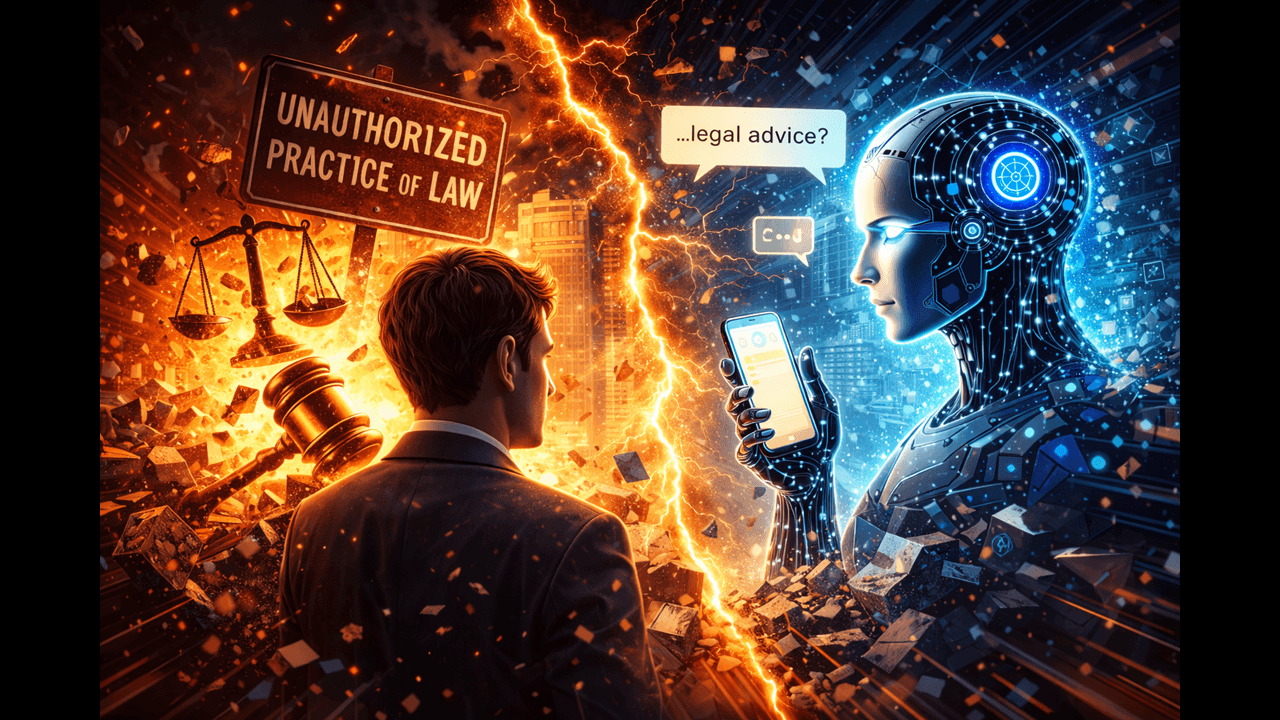
This is the second in the author's three-part series looking at the new physics of legal tech. Here is part 1: The New Physics of Legal Tech: Infrastructure, Capital, and the Coming AI Realignment.
In Part 1 of this series, I described the macro forces shaping legal tech and the broader AI movement, including infrastructure buildout, geopolitical pressure, and U.S. policy. In Part 2, the focus narrows to where that pressure concentrates.
Incremental change will continue in legal tech while pressure builds in the background. New startups will continue to enter the market, and mature ones will begin to consolidate. Revenue and ROI pressure will become more important. Legal innovators can expect more mainstream adoption of AI and an expansion of Agentic AI solutions in 2026.
UPL is At the Center of Colliding Forces
Meanwhile, the mounting pressure will center on unauthorized practice of law (UPL). This is where competing forces will drive transformational change in the legal industry. It is where technology, consumer behavior, ROI pressures, and professional regulation collide, and something must give.
UPL is already bending.
The question is no longer whether the rules make sense in theory, but whether they can be applied consistently in practice as consumer behavior and technology diverge from the rules' design.
A groundswell of activity enabled by the likes of OpenAI's ChatGPT already ignores the current rules. Consumers use AI for many legal tasks, including successfully defending eviction notices in court without an attorney. ChatGPT can even be used to navigate local zoning rules, something I recently had the pleasure of doing.
A key dilemma for regulators is the question of whether or not technology itself can provide legal advice. Intuit's TurboTax has long guided consumers through the compliance task of filing taxes through decision trees and rules. Users of TurboTax walk through dialogues, enter data and facts, and answer questions to complete their return.
ChatGPT takes the question of TurboTax-style products for law and throws gasoline on a simmering fire. When legal guidance is delivered through LLM-driven, conversational systems, it becomes difficult to identify where information ends and advice begins. The lines get blurry fast.
The popularity of ridesharing enabled Uber to skirt local taxi regulations, forcing regulators to respond. Once consumer ridership reached scale, enforcement shifted from a legal question to a political one. The regulatory response to UPL will follow a similar pattern. State supreme courts and bar associations will be slow to act, and popular use will turn enforcement into a political issue. Strict enforcement of UPL risks being perceived as a barrier to participation in the legal system.
It's also worth noting that OpenAI or other LLM providers would be the real defendants in enforcement actions, which adds to the politics.
Regulators will follow, not lead.
There will still be clear-cut situations in which people misrepresent themselves as lawyers, but in practice, the scope of UPL enforcement will shrink.
Access to Justice Is the Ethical Forcing Function
It's no secret that courts have significant backlogs, and access to justice is an ethical imperative to embrace AI's role in law, as it aligns with the core mission of our legal systems.
Damien Riehl has shared how the Minnesota State Bar Association intends to set up an AI Sandbox as a controlled environment for organizations to explore the use of LLMs to support access to justice without fear of UPL prosecution.
Actions like those in Minnesota and in states experimenting with alternative business structures, such as Arizona and Utah, align with the larger forces that are bending UPL.
Lessons From Medical Industry Specialization
Bill Henderson has long noted the parallels and contrasts between the legal industry and specialization within the medical profession. Doctors used to make house calls and handled most medical issues directly. There are now 17 million healthcare workers in the U.S. and only one million doctors. Not all medical tasks require a doctor's advice. This is why there are now physician assistants writing prescriptions and specialists who read X-rays.
In legal, completing a form, navigating the filing process, or just having access to current laws was the domain of lawyers, similar to how all things medical were generally the domain of a doctor. Lawyers have been the experts in all things law to the point that, in my opinion, the lines between legal information and legal advice have not been sufficiently examined. The legal profession is beginning to confront a similar unbundling, accelerated by AI and driven by economics and untapped consumer demand.
The occasional consumer used to consult Nolo Press' publications or LegalZoom for information and guidance through a process like creating a will. But now, information for all types of legal issues is literally at your fingertips with ChatGPT on a smartphone.
Villanova University offers a program to become an immigrant advocate, so individuals can help immigrants navigate the process. While the immigration example is driven by other needs, it illustrates the possibilities for specialization as barriers fall.
What Is the Goal of UPL Regulation In the Future?
AI is the principal catalyst in how the law will be practiced in the future. Consumer behavior, popular opinion, and access to justice are causing UPL to bend.
The larger issue is that lawyers also use AI.
There will be more situations where technology can offer a pro se litigant comparable advice to a good lawyer. There will be more situations where even a good lawyer will have to adjust the value-add they provide and up their game.
Lawyers' use of AI further underscores the challenges posed by the current regulatory framework.
As specialization increases and AI systems perform tasks once reserved exclusively for lawyers, the practical challenge becomes distinguishing legal information from automated reasoning and professional judgment. That distinction is becoming harder to apply consistently.
It also begs the question, "What exactly are we trying to regulate moving forward?"
Capital Doesn't Wait for Regulatory Clarity
Investment in legal technology is now substantial, and history suggests that capital does not look for permission to act. Widespread adoption tends to precede formal rulemaking.
BigLaw is big business and supports the largest corporations in the world. As UPL continues to bend, and capital investment continues, we will see the traditional world of BigLaw flex too.
Part 3 of this series will examine how forces are reshaping legal services for corporations, driving greater automation and expansion of managed legal services, and prompting some interesting responses from BigLaw.
AI was used in support of this article.